
Digital stress can look different for everyone. Some young people notice a fear of missing out, stress about being available for friends online, or a vulnerability to what’s called connection overload. Others may find it difficult to go on platforms without comparing themselves to others or seeking approval from their networks. Spending time mapping out your own experience of digital stress is a worthwhile investment in your well-being goals.
Each step towards recognizing digital stress in your life can be a movement towards more digital peace. Begin by reflecting on which aspects of digital stress show up for you based on the adapted Digital Stress Scale, a research-backed tool for identifying your stress patterns you can explore below. You can then explore digital stress patterns common for each category in Digital Peace Activity 2 and Activity 3.
Using your writing method of choice, work through the exercises below.
Part 1: Self Reflection
For each statement below, choose the option that best describes how often this has been true for you over the past week and write it on your paper or device.
Scale: 1 = Rarely, 2 = Sometimes, 3 = Often
A. Availability stress describes the pressure you may feel to always be reachable.
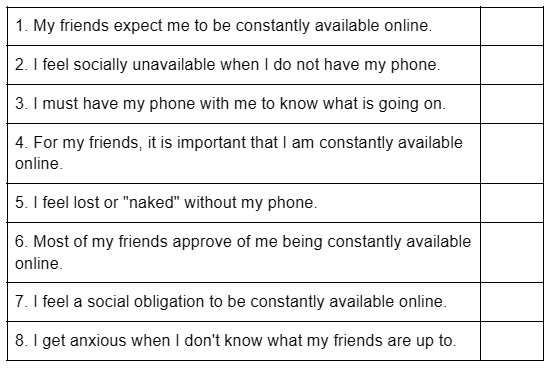
Add your scores, then divide by 8 to get your average.
B. Approval anxiety describes the worry you may feel about how others will respond to what you post. For each statement below, choose the option (1, 2, or 3) that best describes how often this has been true for you over the past week.
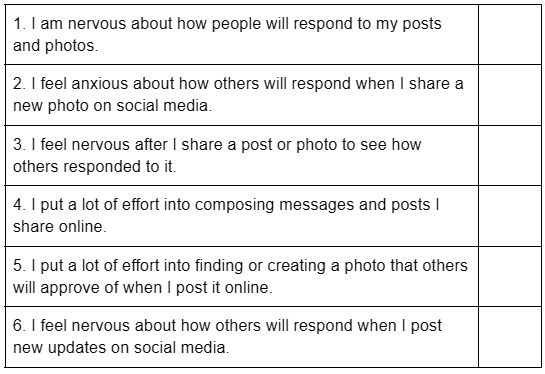
Add your scores and divide by 6 for your average.
C. Fear of missing out (FOMO) describes the worry you may feel that others are having better experiences without you. For each statement below, choose the option (1, 2, or 3) that best describes how often this has been true for you over the past week and write it on your paper or device.
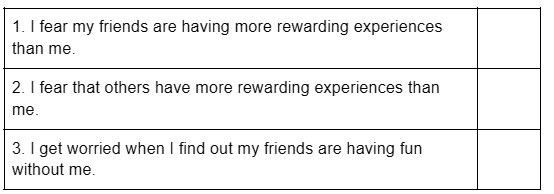
Add your scores, then divide by 3 to get your average.
D. Connection overload describes the feeling of overwhelm you may notice due to the volume and types of notifications and messages you receive. For each statement below, choose the option (1, 2 or 3) that best describes how often this has been true for you over the past week.
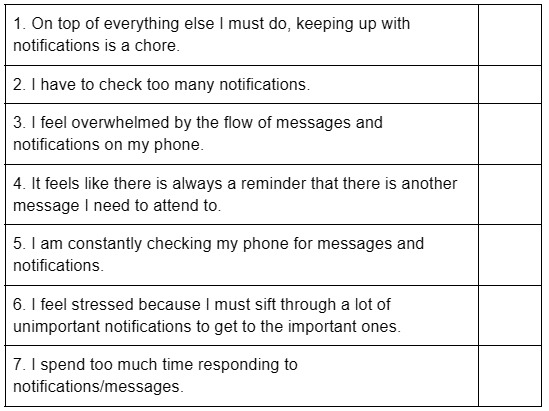
Add your scores, then divide by 7 to get your average.
2. Making sense of your scores
Now, average your scores and see what you can learn about yourself.
Your average score in each category will be between 1 and 3. What might this mean?
- Closer to 1 (Rarely): This area isn’t a major source of digital stress for you right now.
- Closer to 2 (Sometimes): This is an area worth keeping an eye on as a source of stress.
- Closer to 3 (Often): This is an area where digital stress is showing up regularly in your life which is a pattern worth paying closer attention to as you grow your digital peace practices.
Now that you have taken the time to notice which patterns feel most familiar, check out Activity 2 and Activity 3 to explore each pattern more deeply.
Explore all of the Liberate content about digital peace activities:
- Liberate-Digital Peace Article: Finding Your Way to Digital Peace
- Liberate-Digital Peace Activity 1: Map Your Digital Stress
- Liberate-Digital Peace Activity 2: Notice Your Patterns: Availability Stress & Connection Overload
- Liberate-Digital Peace Activity 3: Notice Your Patterns: FOMO & Approval Anxiety
References
- Steele, R.G., Hall, J.A. & Christofferson, J.L. Conceptualizing Digital Stress in Adolescents and Young Adults: Toward the Development of an Empirically Based Model. Clin Child Fam Psychol Rev 23, 15–26 (2020). https://doi.org/10.1007/s10567-019-00300-5
- Hall, J. A., Steele, R. G., Christofferson, J. L., & Mihailova, T. (2021). Development and initial evaluation of a multidimensional digital stress scale. Psychological Assessment, 33(3), 230–242. https://doi.org/10.1037/pas0000979