
Most young people rely on a mix of coping strategies when they’re online or offline. While your options for emotional support can be helpful online, it is valuable to keep direct in-person communication in your toolbox.
Research shows that face-to-face interactions can increase your sense of well-being in the short term. Studies also show that while face-to-face interactions boost well-being more than any other form of communication, you can opt for phone calls, video calls, and texting as alternatives.
This means that you can make your connections count by prioritizing face-to-face time with the people who matter most and choosing voice over text when an in-person interaction isn’t possible.
Reflect on your connections
This activity will support you in reflecting on your connection patterns and shifting towards making connections that best support your well-being.
1. Looking Back
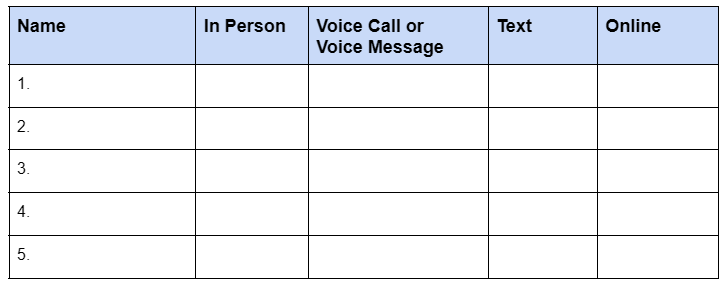
Take a few moments to think about the meaningful connections you had over the last month. A meaningful connection is one with some level of intimacy beyond small talk or sharing brief updates.
Write down the name of a connection and note the type of interaction you had.
Reflections
As you look at your list, do you notice any patterns with your connections over the last month? Is there a balance between the types of contacts you made,or does one type stand out more than the others? What could a more balanced pattern of contact types look like for you in the months ahead?
2. Making Communications Count
Based on what you noticed above, identify one small, specific shift you could make toward more face-to-face or voice contact in the coming week. Make notes on a notebook or device.
- The person I want to connect with:
- The type of contact I want to prioritize:
- One specific moment this week when I could make that happen:
- What I hope that connection will give me:
Remember, more digital peace does not mean avoiding on screen connections altogether. It is about creating space for the kinds of communication that best support your well-being.
Explore all of the Relate content about digital peace activities:
- Relate-Digital Peace Article: Coping On Screen and Off
- Relate-Digital Peace Activity 1: Map Your Coping Toolbox
- Relate-Digital Peace Activity 2: Practice Coping with Intention
- Relate-Digital Peace Activity 3: Make Your Connections Count
References
- Gupta, C., Jogdand, D., & Kumar, M. (2022). Reviewing the impact of social media on the mental health of adolescents and young adults. Cureus, 14(10), e30143. https://doi.org/10.7759/cureus.30143
- Liang, N., Grayson, S. J., Kussman, M. A., Mildner, J. N., & Tamir, D. I. (2024). In-person and virtual social interactions improve well-being during the COVID-19 pandemic. Computers in Human Behavior Reports, 15, Article 100455. https://doi.org/10.1016/j.chbr.2024.100455
- Hollenstein, T., & Faulkner, K. (2024). Adolescent digital emotion regulation. Journal of Research on Adolescence, 34, 1341–1351. https://doi.org/10.1111/jora.13009
- Sharma, M. K., John, N., & Sahu, M. (2020). Influence of social media on mental health: a systematic review. Current opinion in psychiatry, 33(5), 467–475. https://doi.org/10.1097/YCO.0000000000000631