
In the last week, have you considered the number of times you coped with strong emotions off screen by connecting with friends or family? How about the number of times you sought emotional support through a device?
Each day, you can choose how to cope with life’s ups and downs — including on social media. Importantly, your choices occur within the context of digital media use and habits that make many of these coping strategies feel natural, useful, and important for your well-being.
You can find more digital peace by taking the time to understand how you cope both on and off screen. Digital peace can be understood as knowing your own relationship with social media well enough to benefit from its most useful parts. On the other hand, digital stress describes how social media use can lead to challenges with how you think, feel, and experience things physically.

Understanding your coping choices
Consider two example scenarios to help understand how you cope with emotions:
- Think back to a recent moment when you saw something online that stirred your emotions. Did you stay online to process your feelings or did you seek out a trusted person to talk to?
- Now, think about a recent hard day in your life. Did you reach for your devices to cope or did you find yourself seeking out off screen coping tools?
Each of these reflections can teach you something about the connections between your emotional triggers and the coping habits you rely on as you process your feelings and experiences.
Four coping pathways
There are four possible pathways young people may find themselves walking through when coping with a strong emotion on or off screen.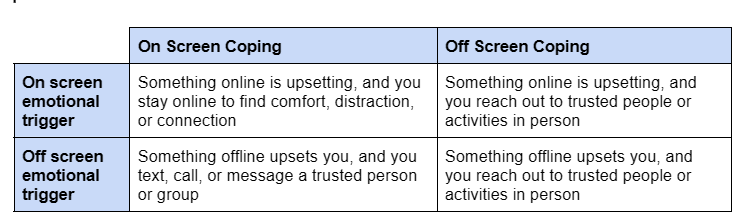
As you explore each pathway, take a few moments to reflect on which ones feel most natural for you. There is no right way to respond to an emotional trigger; however, your default habits may not be the most useful response.
- Can you recall a moment when your coping choice on or off screen made you feel worse instead of better?
- Can you recall a moment where the choice made a real difference?
What helps you choose the right coping tool for the moment?
I can remember times online when someone’s post left me sitting with a mix of heavy emotions, and I opted to text a friend to process them. At other times, I moved to a different part of the platform or another application entirely to work through what I was feeling. There were situations where reaching out to a trusted person was just what I needed to ride the wave of the heavy emotions.
I also remember other situations where I noticed myself in a thinking spiral from the same coping strategy. This taught me that coping is less about finding one approach for every situation and more about paying attention to what is working in real time. I have learned that I make coping choices based on the type of emotional trigger, the availability of trusted people, and sometimes, even the level of stress I’m sitting with that day.

The Takeaway & Closing Reflection
Research on emotional coping explains that being intentional about what and how you are coping is more important than the on or off screen strategy you choose. This means that your voice and choice can support you in reaching for what serves you and moving away from what does not.
I am still finding my way towards digital peace. On good days, I make helpful choices to manage my emotions. On more challenging days, I notice my coping strategies are less helpful than I need them to be. With time, effort, and commitment, my coping toolbox has grown stronger and more reliable. Like me, you already have what you need to add more digital peace to your life.
Try these action steps to support yourself as you move towards the level of well-being you seek — and deserve.
1. Map your coping toolbox. Most young people rely on a mix of coping strategies on and off screen. Do either of these points feel true for you?
- Preferring texting a friend instead of a phone call or meeting up in person.
- Using digital platforms to cope with certain situations.
No matter your preferences, it is important to understand your current coping toolbox to support your well-being goals.
2. Practice coping with intention. Every coping choice you make gives you a window into your coping style. Taking a look at a recent emotional trigger and the choices you made to manage it is an important step towards more digital peace. With each reflection, you can gain insight into which on and off screen coping strategies to add, remove, or strengthen. Growing in this self-knowledge can support you in making more intentional choices the next time an emotional wave greets you.
3. Make your connections count. Turning towards a screen can be a good choice in certain situations. Research shows that connecting with others in person offers more benefits to your well-being. For example:
- Some young people turn to the screen to access trusted people. This may be because in person contact is not available at all or cannot be achieved reliably.
- Other young people have ready access to both on screen and off screen people they trust.
No matter your specific experience, naming the people you can trust can help you turn towards them in the moments that matter.
Explore all of the Relate content about digital peace activities:
- Relate-Digital Peace Article: Coping On Screen and Off
- Relate-Digital Peace Activity 1: Map Your Coping Toolbox
- Relate-Digital Peace Activity 2: Practice Coping with Intention
- Relate-Digital Peace Activity 3: Make Your Connections Count
References
- Hollenstein, T., & Faulkner, K. (2024). Adolescent digital emotion regulation. Journal of Research on Adolescence, 34, 1341–1351. https://doi.org/10.1111/jora.13009
- Sharma, M. K., John, N., & Sahu, M. (2020). Influence of social media on mental health: a systematic review. Current opinion in psychiatry, 33(5), 467–475. https://doi.org/10.1097/YCO.0000000000000631
- Nagata, J.M., Huang, O., Hur, J.O. et al. Health Benefits of Social Media Use in Adolescents and Young Adults. Curr Pediatr Rep 13, 22 (2025). https://doi.org/10.1007/s40124-025-00357-7
- Steele, R.G., Hall, J.A. & Christofferson, J.L. Conceptualizing Digital Stress in Adolescents and Young Adults: Toward the Development of an Empirically Based Model. Clin Child Fam Psychol Rev 23, 15–26 (2020). https://doi.org/10.1007/s10567-019-00300-5