
Can you recall a moment when you noticed an emotion that felt more intense than you could handle? Did the experience cause you to turn away from it? Or, how about a moment when you sat with an emotion gently enough to name and care for it?
The choices you make in the moment to move toward or away from feelings and experiences can impact your emotional well-being and mental health. Your decisions can also teach you about the sense of emotional safety you feel or that you may need in your life. Each opportunity you have to sense what you feel, read the emotional signals, and choose a caretaking response represents an important part of learning about and supporting your safety needs. By the time you reach young adulthood, you will have had thousands of these moments of emotional learning.
Create your safety zone
You can think of an emotional safety zone as the place where you feel safe enough to sense, reflect, and choose a thoughtful response to your emotions. This feeling of being safe enough can help you process your emotions intentionally and then take steps to serve your emotional needs.
What’s your emotional pattern?
Before you walk through this chart of emotional patterns, take a few moments to reflect on a recent emotional moment. Now, read through the chart and track how you process emotions.
Your emotional patterns
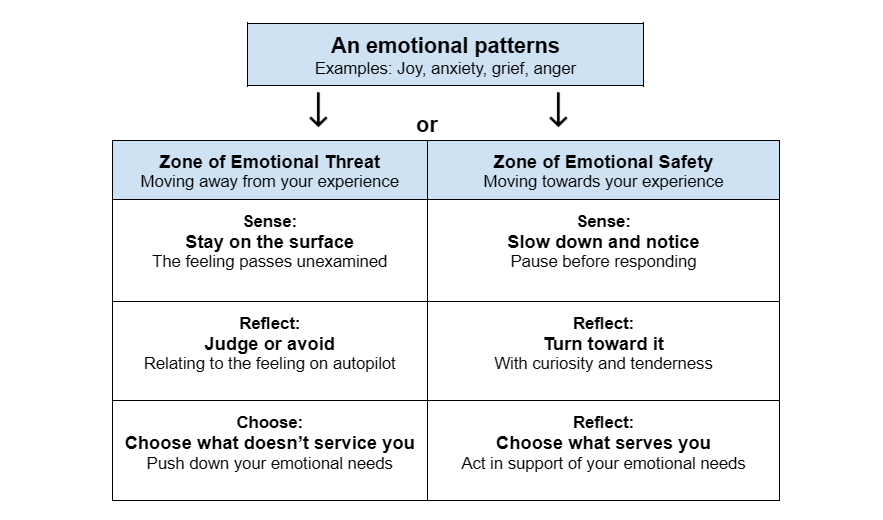
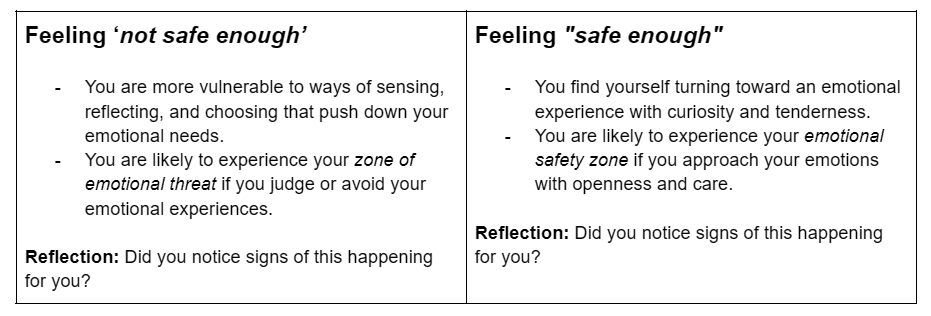
Daily habits that widen your safety zone make turning towards yourself more possible.
Emotional moments are a normal part of daily life and can include a range of emotions from pleasant feelings like joy to unpleasant emotions like anxiety. As you notice your emotions, you can assess whether you also have a feeling of being “safe enough” to meet your emotions fully.
Do you feel “safe enough”?
Feeling “safe enough” is less about the perfect moment or capacity, or even skills. It is more about the comfort and confidence you have developed to tend to your emotions whenever and however they arise.

Personal reflections
Your emotional patterns and your ability to feel safe enough may have begun as an adaptation to the world and people around you. As you continue to explore emotional safety, it is important to reflect on your patterns from a place of kind observation rather than a place of self-judgment. Here’s what that looked like for me.
I struggled with emotional expression as a freshman in college. Like many of my classmates, I found myself suppressing my emotions in hopes of establishing and maintaining relationships with friends and family. Emotional suppression can be strategic and useful in situations where fully revealing your emotions could lead to harmful consequences.
However, I recall many times when I suppressed my true feelings in ways that made it harder for me to ask for and receive the support I needed. Looking back, I can see how much time I spent in the zone of emotional threat. This led to missed opportunities for connection with myself and others.
Healthy Habits
It can take time to unlearn habits that don’t serve you and choose to honor your needs instead. It can also take time to better understand how the familial, social, cultural, and historical lessons you’ve been taught are shaping the emotional patterns of your inner world.
- For example, did you…
-
- Learn that you are expected to judge or avoid certain feelings in specific situations?
- Grow up viewing tenderness toward your emotional experience as a form of weakness?
While you can’t change the lessons you’ve absorbed, you can pivot away from the related habits that make turning toward your emotions less possible.

Four ways to turn toward yourself — and create emotional safety
- Identify your emotional patterns. Work through the chart above and learn to be more intentional about which emotions you nurture and which you move away from in support of your well-being.
- Reflect on your patterns. Take time each day to consider how you’re processing your feelings. Can you identify situations, people, and your changing capacity that influence your emotional patterns?
- Show up for yourself. Consider your emotional needs each day with curiosity and tenderness.
- Maintain your safety zone. Caring for yourself requires daily upkeep — adopt emotional habits that support you to:
- Sense your emotions
- Reflect on their meaning
- Choose supportive responses to them
As a young person managing school, family, work and friends, it can be challenging to pay attention to your emotional capacity and show up for yourself early enough. However, if you notice your emotional patterns drifting toward the zone of emotional threat, it can be a clue that more daily upkeep is needed. It is key to make these “safe enough” efforts into a habit rather than a reaction to a particular situation.
The Takeaway
Daily habits that widen your sense of safety make turning toward yourself more possible. With reflection, planning and practice, the safe enough version of yourself can show up more often. As you work through the activities in the Liberate pillar, remember that you have the voice and the choice within to show up for yourself beautifully each day.
Three action steps you can take:
1. Reflect on your emotional patterns.
Spend some time exploring your emotional patterns to determine which emotional zone you find yourself in most often. The more you understand your learned patterns, the better able you will be to intentionally keep what is serving you and replace what is harmful to you.
2. Expand your emotional coping toolbox.
As you increase helpful habits and practice new ones, you will also need access to a range of emotional coping strategies to care for yourself. Take a look at the suggestions in the Liberate pillar and decide which you can add to your repertoire as you pivot toward increasing your felt sense of emotional safety.
3. Create new emotional habits.
After reflecting on your emotional patterns, choose either an old habit to strengthen or a new habit to adopt for seven days. Consider creating a log or journal to write about or track your emotional habits as you shift towards habits that honor your emotional needs. You can use the emotional habit log in the activities below to support shifting towards habits that honor your emotional needs.
Get started with these activities:
- Liberate-Safety Activity 1: Reflect on Your Emotional Patterns
- Liberate-Safety Activity 2: Choose Supportive Emotional Habits
- Liberate-Safety Activity 3: Create New Emotional Habits
References
- Lynch, J. M., Stange, K. C., Dowrick, C., Getz, L., Meredith, P. J., Van Driel, M. L., Harris, M. G., Tillack, K., & Tapp, C. (2025). The sense of safety theoretical framework: A trauma-informed and healing-oriented approach for whole person care. Frontiers in Psychology, 15, 1441493. https://doi.org/10.3389/fpsyg.2024.1441493
- Podolan, M., & Gelo, O. C. G. (2024). The role of safety in change-promoting therapeutic relationships: An integrative relational approach. Clinical Neuropsychiatry: Journal of Treatment Evaluation, 21(5), 403–417.
- Syropoulos, S., Leidner, B., Mercado, E., Li, M., Cros, S., Gómez, A., Baka, A., Chekroun, P., & Rottman, J. (2024). How safe are we? Introducing the multidimensional model of perceived personal safety. Personality and Individual Differences, 224, 112640. https://doi.org/10.1016/j.paid.2024.112640
- Wylie, M. S., De France, K., & Hollenstein, T. (2022). Adolescents suppress emotional expression more with peers compared to parents and less when they feel close to others. International Journal of Behavioral Development, 47(1), 1–8. https://doi.org/10.1177/01650254221132777