
After reflecting on your emotional patterns in Activity 1, this activity can help you identify emotional habits that support your mental health and emotional well-being. Start by reflecting on your preferred emotional coping style and then select a few healthy habits to explore over the next few days. Research shows that these action steps can strengthen your ability to flex and pivot where needed to support your emotional needs.
Step 1: Reflect on your preferences
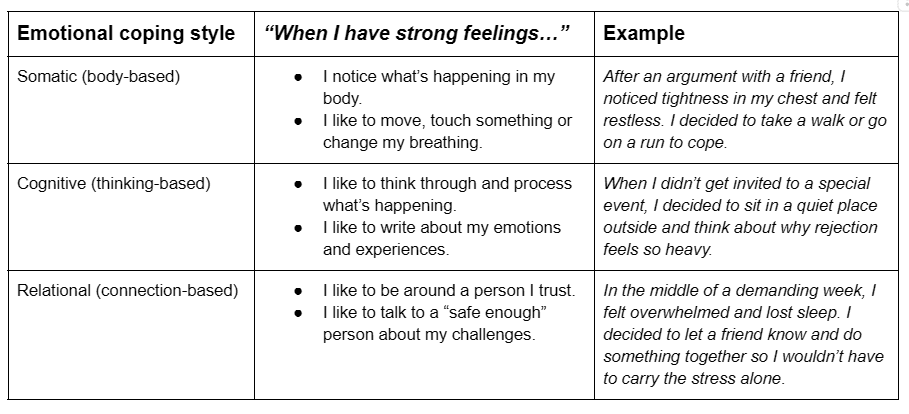
Take a moment to identify the emotional coping habits that feel most natural to you. Do you find yourself drawn to somatic exercises that connect with your body’s sensations as a clue to your caretaking needs? Or, do you prefer focusing on your thoughts? Or, maybe you find support by connecting with others.
Let’s look at a few examples:
Step 2: Explore other emotional coping strategies
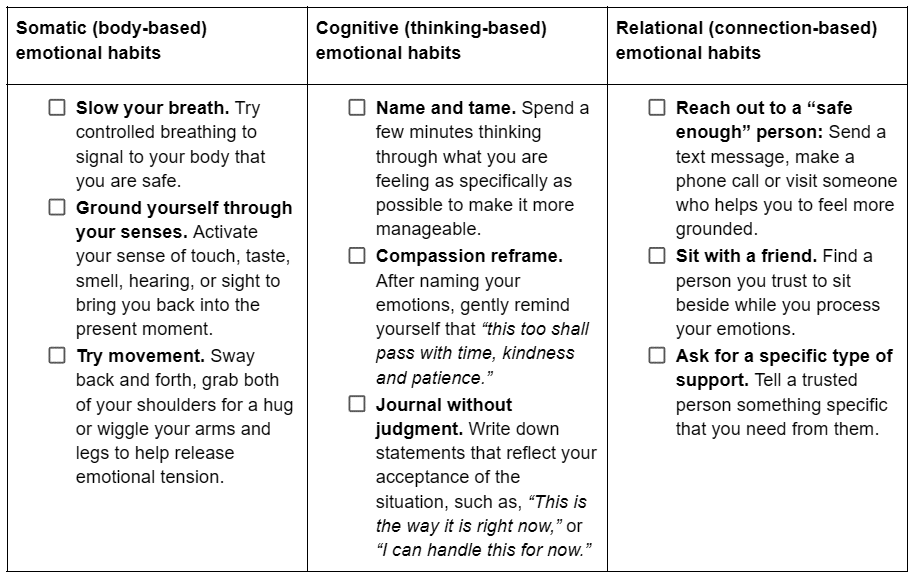
Even if your preferences lean toward a particular coping style, it is important to consider trying different approaches. This can be especially helpful if you feel your current emotional habits are less effective than you’d like. Try at least one of the following supportive emotional habits from each category and track your progress in Activity 3.
Explore all of the Liberate content about safety activities:
- Liberate-Safety Article: Who Are You When You Feel “Safe Enough”
- Liberate-Safety Activity 1: Reflect on Your Emotional Patterns
- Liberate-Safety Activity 2: Choose Supportive Emotional Habits
- Liberate-Safety Activity 3: Create New Emotional Habits
References
Haag, A., Bagrodia, R., & Bonanno, G. A. (2024). Emotion regulation flexibility in adolescents: A systematic review from conceptualization to methodology. Clinical Child and Family Psychology Review, 27(3), 697–713. https://doi.org/10.1007/s10567-024-00483-6
Lynch, J. M., Stange, K. C., Dowrick, C., Getz, L., Meredith, P. J., Van Driel, M. L., Harris, M. G., Tillack, K., & Tapp, C. (2025). The sense of safety theoretical framework: A trauma-informed and healing-oriented approach for whole person care. Frontiers in Psychology, 15, 1441493. https://doi.org/10.3389/fpsyg.2024.1441493
Pederson, L. D. (2015). Skills training. In L. D. Pederson (Ed.), Dialectical behavior therapy: A contemporary guide for practitioners. https://doi.org/10.1002/9781118957882.ch19