
After reflecting on your emotional patterns in Activity 1 and supportive emotional habits in Activity 2, this activity can support you in choosing a habit to strengthen or adopt over the course of a week.
Start by identifying your emotional pattern (if you haven’t already), then work through the additional steps and the reflection exercise. Research shows that taking these steps can strengthen your ability to flex and pivot to support your emotional needs and well-being.
Step 1: Identify your emotional pattern
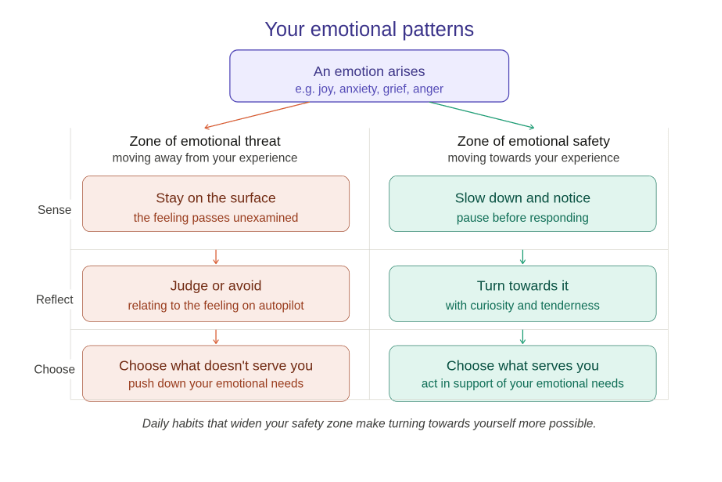
Now, grab a piece of paper, your journal, or device and work through the steps and questions below.
Step 2: Read your context
Before choosing a habit, think about a situation where you might practice moving toward your emotional needs. The more specific you are about the situation, the more useful your habit will be.
- What type of moment tends to pull you toward the zone of emotional threat?
- What does that type of moment typically demand of you emotionally?
- What signals in your body, thoughts, or behavior tell you that you are moving away from your emotional experience during that moment?
Step 3: Choose your habit
Choose one habit from Activity 2 or name your own that you will practice for the next seven days. It can be a new habit or one you are already building.
- The habit I am committing to is:
- Is this a habit you are strengthening or a new one you are adopting?
- When and where will you practice this habit? (Be as specific as possible about the day, time, or context)
- What might get in the way of practicing this habit?
- How will you handle it if something gets in the way?
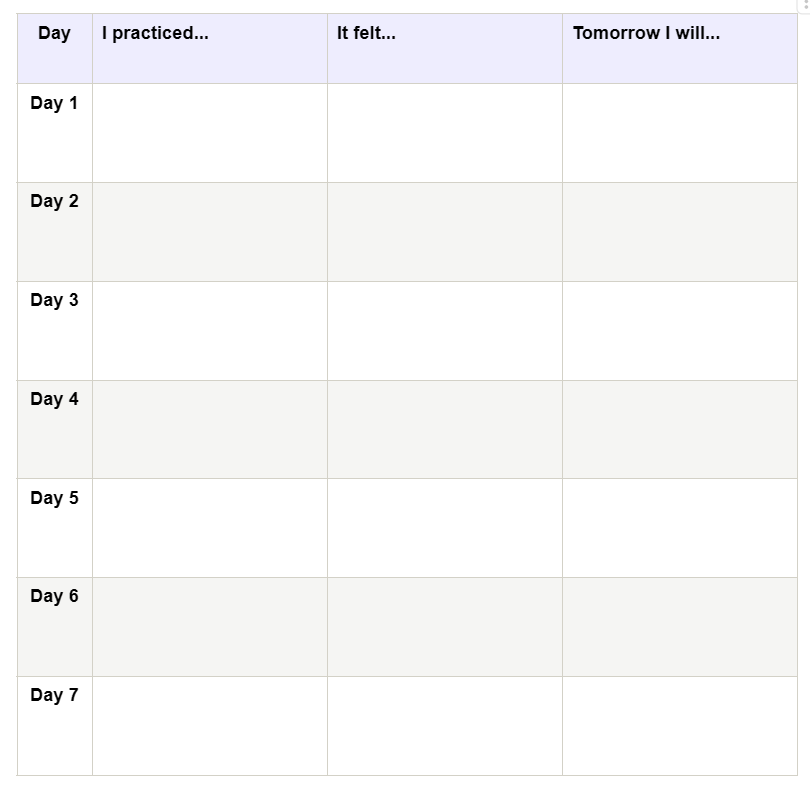
Step 4: Log your progress for the week
Use this log or a piece of paper to track your progress. Each day, note what you practiced, how it felt, and what you will carry forward or adjust. Remember, small shifts count. Answer these questions on your paper, journal, or device. You may wish to sketch this grid on paper to make this easier to track over time.
Step 5: End of week reflection
Take a few quiet minutes to reflect on your week before moving on. Answer these questions on your paper, journal, or device.
- What did you learn about yourself through practicing this habit?
- Did this habit help you move toward your emotional experience more often? What did that feel like?
- What would you like to carry forward into the next 7 days?
- Daily habits that widen your safety zone make turning toward yourself more possible.
Explore all of the Liberate content about safety activities:
- Liberate-Safety Article: Who Are You When You Feel “Safe Enough”
- Liberate-Safety Activity 1: Reflect on Your Emotional Patterns
- Liberate-Safety Activity 2: Choose Supportive Emotional Habits
- Liberate-Safety Activity 3: Create New Emotional Habits
References
Haag, A., Bagrodia, R., & Bonanno, G. A. (2024). Emotion regulation flexibility in adolescents: A systematic review from conceptualization to methodology. Clinical Child and Family Psychology Review, 27(3), 697–713. https://doi.org/10.1007/s10567-024-00483-6
Lynch, J. M., Stange, K. C., Dowrick, C., Getz, L., Meredith, P. J., Van Driel, M. L., Harris, M. G., Tillack, K., & Tapp, C. (2025). The sense of safety theoretical framework: A trauma-informed and healing-oriented approach for whole person care. Frontiers in Psychology, 15, 1441493. https://doi.org/10.3389/fpsyg.2024.1441493
Pederson, L. D. (2015). Skills training. In L. D. Pederson (Ed.), Dialectical behavior therapy: A contemporary guide for practitioners. https://doi.org/10.1002/9781118957882.ch19