
Think of a recent emotional moment you experienced. Now, grab a journal, a piece of paper, or your phone or laptop — and then use the chart below to explore your experience and where you landed. You’ll end reflecting on and honing in on the emotional habits you can set aside and those you want to keep and strengthen.
An emotion arose for me:
(Name it at the top of your page)
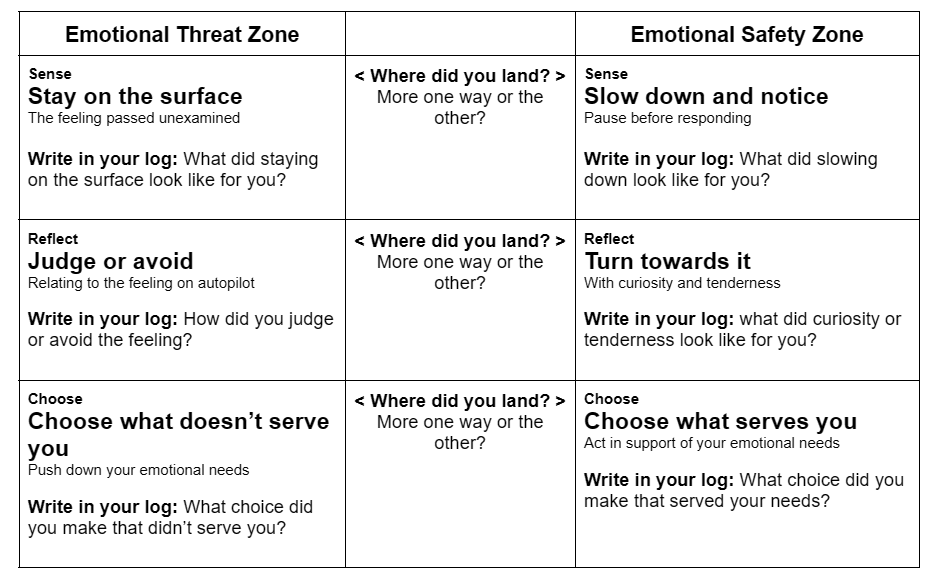
Overall Reflection
Answer these questions in your log:
- Which zone do you find yourself in most often? What patterns do you notice?
- Which patterns are serving you? Which would you like to shift?

Explore all of the Liberate content about safety activities:
- Liberate-Safety Article: Who Are You When You Feel “Safe Enough”
- Liberate-Safety Activity 1: Reflect on Your Emotional Patterns
- Liberate-Safety Activity 2: Choose Supportive Emotional Habits
- Liberate-Safety Activity 3: Create New Emotional Habits
References
Lynch, J. M., Stange, K. C., Dowrick, C., Getz, L., Meredith, P. J., Van Driel, M. L., Harris, M. G., Tillack, K., & Tapp, C. (2025). The sense of safety theoretical framework: A trauma-informed and healing-oriented approach for whole person care. Frontiers in Psychology, 15, 1441493. https://doi.org/10.3389/fpsyg.2024.1441493
Podolan, M., & Gelo, O. C. G. (2024). The role of safety in change-promoting therapeutic relationships: An integrative relational approach. Clinical Neuropsychiatry: Journal of Treatment Evaluation, 21(5), 403–417.
Syropoulos, S., Leidner, B., Mercado, E., Li, M., Cros, S., Gómez, A., Baka, A., Chekroun, P., & Rottman, J. (2024). How safe are we? Introducing the multidimensional model of perceived personal safety. Personality and Individual Differences, 224, 112640. https://doi.org/10.1016/j.paid.2024.112640