
As you work toward being more open and vulnerable in your connections with others, you will come across moments when you feel drawn to express a need or appreciation in a relationship. These moments are opportunities to have “safe enough” conversations that bring you and another person closer to being truly seen.
One way to start is by having conversations in new ways. Across the ingredients of “safe enough” relationships, select one or two conversation starters to try over the next two weeks. Be sure to journal about your experiences before, during, and after each conversation.
Part 1: Choose your starter
Think about the two or three people in your life that feel “safe enough” to share different parts of yourself with from Activity 1 in the Relate pillar. Now, explore each of the following vulnerability ingredients and plan to have a conversation with at least one person you trust. You can decide to start with what you value about the connection or with what you need from the connection for it to feel safer being seen.
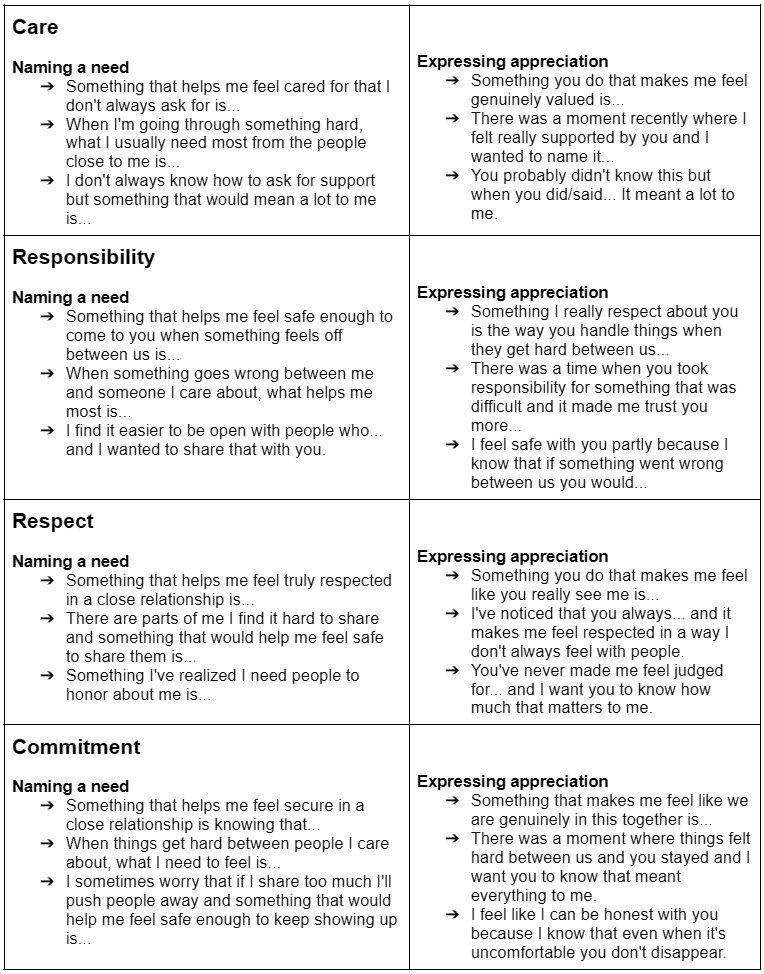
Part 2: Journal reflections
As you practice being vulnerable with others, pause to reflect on questions and to track your progress and growth. Try these reflection questions:
- Before: What was I feeling or thinking before I tried this?
- During: What did I notice in myself as it was happening?
- After: How did it go? How did this person respond? What did this moment tell me about this relationship or about myself?
As you test out the conversation starters above, choose one of these gratitude practices after each journal entry about your experience.
Gratitude practices
- What is one thing you’re grateful for about the person you selected?
- What is one thing you’re grateful for about yourself in this relationship?
- What is one thing you’re most proud of as you practiced being vulnerable?
Journal Entry 1: Today, I’m grateful for…
Journal Entry 2: Today, I’m grateful for…
Journal Entry 3: Today, I’m grateful for…
Explore all of the Relate pillar’s safety activities:
- Relate-Safety Article: What Makes it Safe Enough to be Seen?
- Relate-Safety Activity 1: Relationship Temperature Check
- Relate-Safety Activity 2: Vulnerability Practice Log
- Relate-Safety Activity 3: Having Safe Enough Conversations
References
- Lynch, J. M., Stange, K. C., Dowrick, C., Getz, L., Meredith, P. J., Van Driel, M. L., Harris, M. G., Tillack, K., & Tapp, C. (2025). The sense of safety theoretical framework: A trauma-informed and healing-oriented approach for whole person care. Frontiers in Psychology, 15, 1441493. https://doi.org/10.3389/fpsyg.2024.1441493
- Midford, R., Nutton, G., Hyndman, B., & Silburn, S. (Eds.). (2020). Health and education interdependence: Thriving from birth to adulthood. Springer.
- Podolan, M., & Gelo, O. C. G. (2024). The role of safety in change-promoting therapeutic relationships: An integrative relational approach. Clinical Neuropsychiatry: Journal of Treatment Evaluation, 21(5), 403–417.
- Wylie, M. S., De France, K., & Hollenstein, T. (2022). Adolescents suppress emotional expression more with peers compared to parents and less when they feel close to others. International Journal of Behavioral Development, 47(1), 1–8. https://doi.org/10.1177/01650254221132777