
Reflecting on emotions and experiences is a way to understand yourself and others. Your ability to thoughtfully care for your emotional needs will grow your emotional courage over time. This is the final part of your journey through the emotional zone of safety.
This step involves being proactive in supporting yourself through what is showing up. You will practice this skill by learning about common emotional needs and coping strategies.
Step 1: Pause to consider how you experience emotions
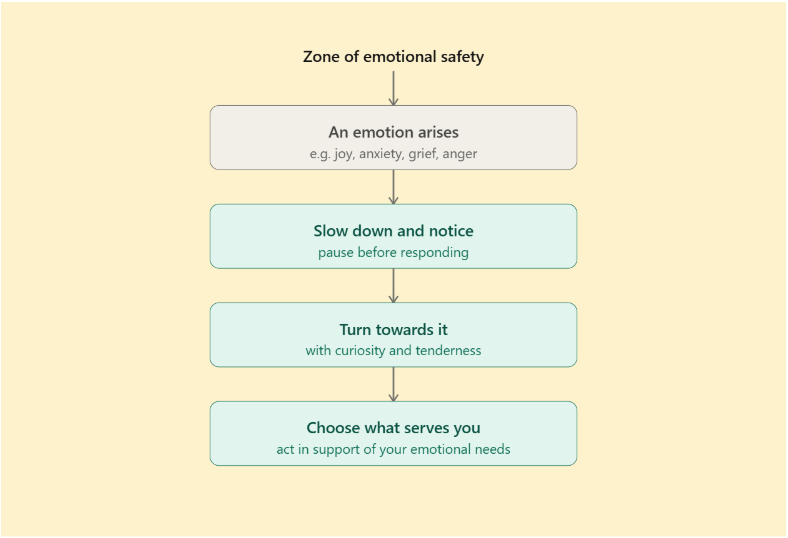
Trusting that you are capable of caring for yourself through challenging emotions is important for your mental health and emotional well-being. These creative practices will support you in choosing what serves you. Be sure to set aside time to reflect on what this practice brings up for you.
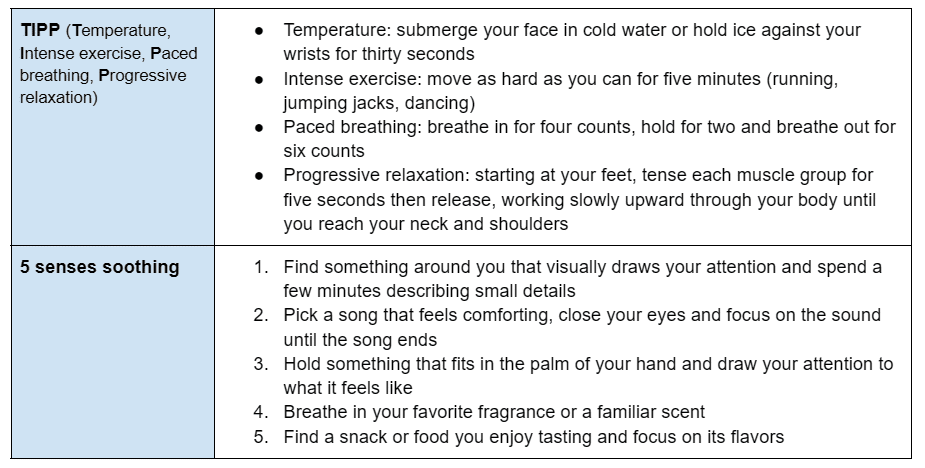
Step 2: When the emotion feels physically strong
Step 3: When the emotion feels too big to sit with safely
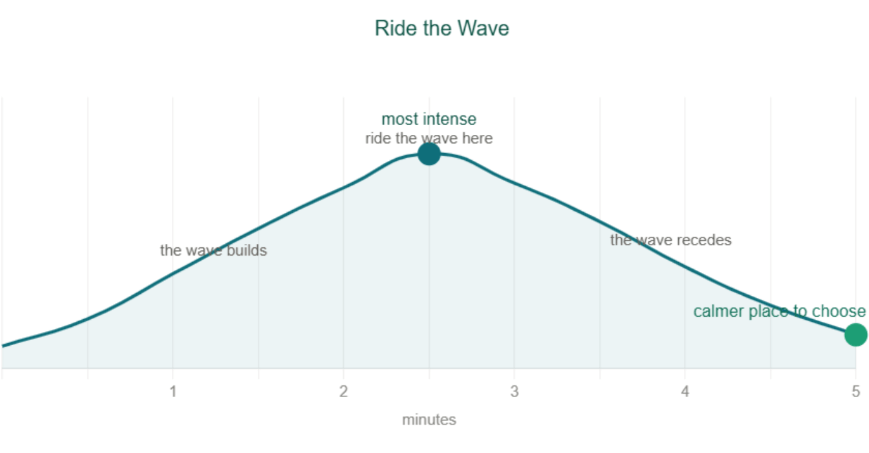
- Step back and observe the emotion. Notice where it lives in your body without judging it or pushing it away. Remind yourself that “I have ridden waves like this before, I can sit with this while it rises.”
- Imagine yourself on a surfboard as the emotion builds. The surfboard allows you to stay on top of it rather than being pulled under the emotional overwhelm.
- Breathe slowly for four counts, hold your breath for two counts and let the exhale be long and slow over six counts.
- Remind yourself that you are not the emotions you are feeling and that you do not need to act on them immediately. Tell yourself “I only need to ride this emotion until it reaches the shore.”
- As the intensity peaks and begins to fade, visualize the wave washing out and leaving you with enough room to act in support of your emotional needs.
Explore all of the Create content on safety:
- Create-Safety Article: Who are you when you create?
- Create-Safety Activity 1: Notice Your Emotional Experience
- Create-Safety Activity 2: Turn Towards Your Emotional Experience
- Create-Safety Activity 3: Act in Support of Your Emotional Needs
References
- Haag, A., Bagrodia, R., & Bonanno, G. A. (2024). Emotion regulation flexibility in adolescents: A systematic review from conceptualization to methodology. Clinical Child and Family Psychology Review, 27(3), 697–713. https://doi.org/10.1007/s10567-024-00483-6
- Lynch, J. M., Stange, K. C., Dowrick, C., Getz, L., Meredith, P. J., Van Driel, M. L., Harris, M. G., Tillack, K., & Tapp, C. (2025). The sense of safety theoretical framework: A trauma-informed and healing-oriented approach for whole person care. Frontiers in Psychology, 15, 1441493. https://doi.org/10.3389/fpsyg.2024.1441493
- Pederson, L. D. (2015). Skills training. In L. D. Pederson (Ed.), Dialectical behavior therapy: A contemporary guide for practitioners. https://doi.org/10.1002/9781118957882.ch19