
When emotions show up, it is an invitation to understand yourself and your needs more fully. Your ability to sit with and welcome your emotional experience will grow your emotional courage over time. This is the second part of your journey through the emotional zone of safety. (See activity 1 ) This step involves being tender and curious about what is showing up. You will practice this skill by writing a compassion letter to someone other than yourself.
Step 1: Pause to consider how you experience emotions
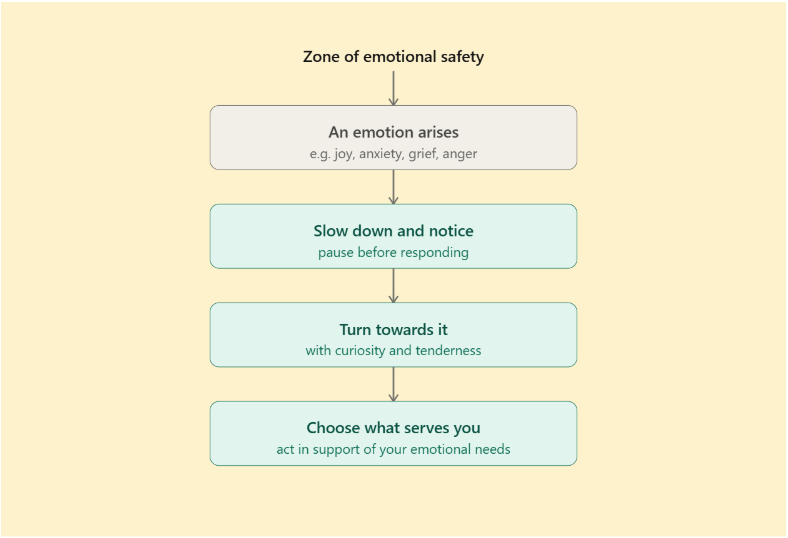
Trusting that you are capable of meeting your emotions and staying with them enough to decide next steps is an act of self care. This creative practice will support you in turning toward your emotions with more compassion. Be sure to set aside time to reflect on what this practice brings up for you.
Step 2: Name the feeling(s)
- Spend some time reflecting on a recent moment where you felt overwhelmed by one or more feelings. If you need help identifying these feelings, use the feelings wheel for inspiration.
The emotions I felt were __________, __________ and ________. - Close your eyes and spend a few moments visualizing another person carrying the feelings you just described. You can picture someone close to you or a stranger you’ve seen. Imagine what they look like, how they feel and how these feelings are affecting you physically and mentally.
Step 3: Write a letter
Now, let’s write a letter that expresses how you feel. Grab a piece of paper, your journal, or a device and work through each of these prompts to write a letter of compassion to this person. You can use the words that feel most natural to you.
- If you were sitting beside this person right now, what would you say first?
- What part of their experience do you most want them to feel understood about?
- What would you want to say to them if they are being hard on themselves?
- What do you want them to know about their ability to move through this difficult moment?
- What permission would you give them that they may not be giving themselves?
- What final words would you leave them with as a reminder they can return to?
Step 4: Reflect
Read back what you have written or typed out loud. Once done, ask yourself: Is there anything I shared with them that I needed to hear, too?
Explore all of the Create content on safety:
- Create-Safety Article: Who are you when you create?
- Create-Safety Activity 1: Notice Your Emotional Experience
- Create-Safety Activity 2: Turn Towards Your Emotional Experience
- Create-Safety Activity 3: Act in Support of Your Emotional Needs
References
- Lynch, J. M., Stange, K. C., Dowrick, C., Getz, L., Meredith, P. J., Van Driel, M. L., Harris, M. G., Tillack, K., & Tapp, C. (2025). The sense of safety theoretical framework: A trauma-informed and healing-oriented approach for whole person care. Frontiers in Psychology, 15, 1441493. https://doi.org/10.3389/fpsyg.2024.1441493
- Midford, R., Nutton, G., Hyndman, B., & Silburn, S. (Eds.). (2020). Health and education interdependence: Thriving from birth to adulthood. Springer.
- Podolan, M., & Gelo, O. C. G. (2024). The role of safety in change-promoting therapeutic relationships: An integrative relational approach. Clinical Neuropsychiatry: Journal of Treatment Evaluation, 21(5), 403–417.