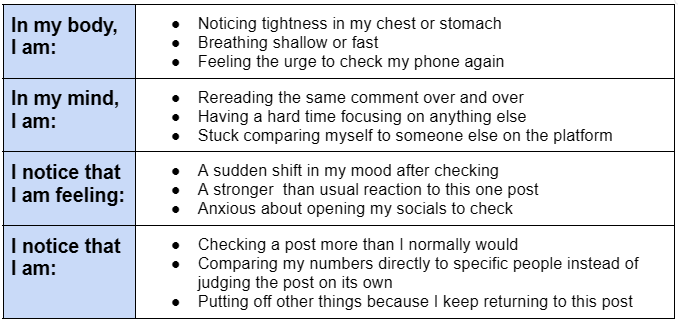
While content creation can be a path towards more creativity in your daily life, it can also leave you with more digital stress than digital peace. The risks of this stress are highest in the period after publishing content. It is important to watch for signals that digital stress is showing up for you and to create a toolbox that can support you through the harder moments of your creative process. You can use the tables below to learn more about common signals and creative strategies for resets when needed.
Digital stress signals
Support yourself with these grounding practices
When digital stress signals appear, you can try the grounding practices below. As you learn which supports help you reset the most (and which don’t), you can create the toolbox that works best for you.
- Hold an ice cube in your hand until it melts or the sensation becomes too intense.
- Walk briskly or jog for 15 minutes.
- Do jumping jacks or jump rope for a few minutes.
- Dance to one fast song, moving your whole body.
- Breathe in a box pattern: Inhale for 4, hold for 4, exhale for 4, hold for 4, and repeat.
- Inhale normally, then exhale slowly through a straw (real or imagined) until your lungs are empty.
- Tense each muscle group for 5 seconds, then release, working from your feet up to your face.
- Squeeze a stress ball tightly for a few seconds, then release.
- Shake your arms, legs, and torso vigorously for 60 seconds.
- Apply a cold pack to your face, neck, or wrists for a few seconds at a time.
- Hum or sing a slow tune and feel your breath and the melody in your body.
- Stretch or move through a few yoga poses at your own pace.
- Write in a journal for 5 minutes without stopping to edit.
- Step outside and take a few slow breaths of fresh ai
Explore all of the Create content about digital peace activities:
- Create-Digital Peace Article: How to Share Online Without Losing Yourself
- Create-Digital Peace Activity 1: Strengthen Your Creative Practices
- Create-Digital Peace Activity 2: Care for Yourself After You Publish
- Create-Digital Peace Activity 3: Create a Reset Toolbox for Hard Moments
References
- Midgley, C., Thai, S., Lockwood, P., Kovacheff, C., & Page-Gould, E. (2021). When every day is a high school reunion: Social media comparisons and self-esteem. Journal of Personality and Social Psychology, 121(2), 285–307. https://doi.org/10.1037/pspi0000336
- Cully, J.A., Dawson, D.B., Hamer, J., & Tharp, A.L. 2020. A Provider’s Guide to Brief Cognitive Behavioral Therapy. Department of Veterans Affairs South Central MIRECC, Houston, TX.
- https://www.aap.org/en/patient-care/media-and-children/center-of-excellence-on-social-media-and-youth-mental-health/qa-portal/qa-portal-library/qa-portal-library-questions/social-media-and-creativity/?srsltid=AfmBOor-BaoDIn3rvMCpFmxCO5AWb2y0osgYCAUR78GSsJDb0Ss1c4Yi
- Steele, R.G., Hall, J.A. & Christofferson, J.L. Conceptualizing Digital Stress in Adolescents and Young Adults: Toward the Development of an Empirically Based Model. Clin Child Fam Psychol Rev 23, 15–26 (2020). https://doi.org/10.1007/s10567-019-00300-5
- Hall, J. A., Steele, R. G., Christofferson, J. L., & Mihailova, T. (2021). Development and initial evaluation of a multidimensional digital stress scale. Psychological Assessment, 33(3), 230–242. https://doi.org/10.1037/pas0000979
- Hollenstein, T., & Faulkner, K. (2024). Adolescent digital emotion regulation. Journal of Research on Adolescence, 34, 1341–1351. https://doi.org/10.1111/jora.13009
- Sharma, M. K., John, N., & Sahu, M. (2020). Influence of social media on mental health: a systematic review. Current opinion in psychiatry, 33(5), 467–475. https://doi.org/10.1097/YCO.0000000000000631