
The steps you take when developing content and social posts can strengthen your creativity. The creative practices you use can support your emotional well-being by creating opportunities for emotional processing and regulation as well as for self-expression and social connection.
Throughout the creative process, you may experience digital stress that limits your ability to reap these benefits. The risks of this stress are highest in the period after publishing content. Approval anxiety and social comparison anxiety are two common types of digital stress related to social media and are defined as:
- Approval anxiety describes the worry you may feel about how others will respond to what you post.
- Social comparison anxiety describes the worry you may feel when measuring your own life, appearance, or content against others’ around you or in your online networks.
Let’s explore how these forms of digital stress can affect your creative process and specific strategies for achieving digital peace while using social media.
Steps in the creative process
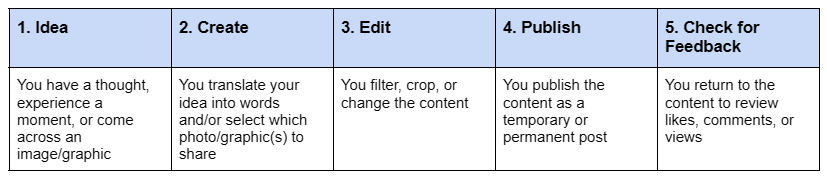
On each digital or social platform, you may follow basic creative steps that end with sharing your content with your audience. This table describes each of the five steps. After you review the table, respond to the prompts below.
Journal prompts
- In general, how does your creative process on your digital platforms feel to you? Where do you notice the most opportunities to lean into the creative elements of each step?
- As you walk through each step of the creative process, where do you notice approval anxiety showing up most in your experience? Does anxiety related to social comparison show up for you, and if so, in which steps?
Creative practices for managing digital stress
To gain the benefits of social media and reduce your digital stress, focus on strengthening your content creation process. This entails having a clear sense of your post goals, paying attention to your inner world, and keeping yourself connected to the creative process itself.
The reflections below can help lower your risk of digital stress as you create, edit, publish, and review feedback on your social posts.
Begin your process. Ask yourself “why am I posting?” to better understand the reason and motivations. Throughout your process, return to this question as a guide for the choices you make to create, edit, publish, and review feedback. For example:
- Am I posting to express what I feel, think, or have been doing to others?
- Am I posting to feel more connected or to create connections in my social network?
- Am I posting to save a memory of this important moment in my life?
- Am I posting to improve a specific skill or to learn something new?
- Am I posting to seek approval from others about what I feel, think, or have been doing?
- Am I posting to share information with others?
Reviewing feedback. Take time to notice what you think and feel about the type, amount, and pacing of engagement with your content. Consider your post goals and how they are connected, if at all, to engagement with the post.
Process emotions that show up. If you notice difficult thoughts about the feedback you are receiving, it is important to check in on your immediate needs before deciding to respond to others. Here are a few common thinking pitfalls related to approval anxiety and social comparisons, along with a suggestion for managing them.
- Mental filtering: Focusing on one or a few negative reactions while ignoring more positive feedback.
- Mind reading: Assuming what others think or feel about you based on the type, amount, and pacing of engagement.
- Personalization: Believes that another person’s content having higher or more quality engagement than yours is proof of your shortcomings.
- Discounting the positive: Minimizing the value of positive feedback instead of accepting it at face value.
- Upward comparison: Judging your own worth by measuring your engagement type, amount, and pacing against others.
If these pitfalls show up as you review feedback, pause to notice them and then ask yourself “what is the evidence supporting this thought, and what might I be leaving out?” Often, these thinking pitfalls occur when digital stress clouds your judgment. If you are feeling uncomfortable levels of stress, seek out options for taking care of yourself, including the suggestions in Activity 2.
Explore all of the Create content about digital peace activities:
- Create-Digital Peace Article: How to Share Online Without Losing Yourself
- Create-Digital Peace Activity 1: Strengthen Your Creative Practices
- Create-Digital Peace Activity 2: Care for Yourself After You Publish
- Create-Digital Peace Activity 3: Create a Reset Toolbox for Hard Moments
References
- Midgley, C., Thai, S., Lockwood, P., Kovacheff, C., & Page-Gould, E. (2021). When every day is a high school reunion: Social media comparisons and self-esteem. Journal of Personality and Social Psychology, 121(2), 285–307. https://doi.org/10.1037/pspi0000336
- Cully, J.A., Dawson, D.B., Hamer, J., & Tharp, A.L. 2020. A Provider’s Guide to Brief Cognitive Behavioral Therapy. Department of Veterans Affairs South Central MIRECC, Houston, TX.
- https://www.aap.org/en/patient-care/media-and-children/center-of-excellence-on-social-media-and-youth-mental-health/qa-portal/qa-portal-library/qa-portal-library-questions/social-media-and-creativity/?srsltid=AfmBOor-BaoDIn3rvMCpFmxCO5AWb2y0osgYCAUR78GSsJDb0Ss1c4Yi
- Steele, R.G., Hall, J.A. & Christofferson, J.L. Conceptualizing Digital Stress in Adolescents and Young Adults: Toward the Development of an Empirically Based Model. Clin Child Fam Psychol Rev 23, 15–26 (2020). https://doi.org/10.1007/s10567-019-00300-5
- Hall, J. A., Steele, R. G., Christofferson, J. L., & Mihailova, T. (2021). Development and initial evaluation of a multidimensional digital stress scale. Psychological Assessment, 33(3), 230–242. https://doi.org/10.1037/pas0000979
- Hollenstein, T., & Faulkner, K. (2024). Adolescent digital emotion regulation. Journal of Research on Adolescence, 34, 1341–1351. https://doi.org/10.1111/jora.13009
- Sharma, M. K., John, N., & Sahu, M. (2020). Influence of social media on mental health: a systematic review. Current opinion in psychiatry, 33(5), 467–475. https://doi.org/10.1097/YCO.0000000000000631